
How DeFi Insurance is Revolutionizing Risk Management in Crypto Assets: Analysis
Updated: Aug 3
Decentralized Finance (DeFi) is a financial frontier unlike any other. It is a permissionless, hyper-efficient ecosystem where anyone with an internet connection can trade, borrow, and lend without a bank in sight.
But this absolute freedom comes with a terrifying caveat. There is no FDIC insurance. There is no central authority to call if things go wrong. In the early days of DeFi, the mantra was simple and ruthless: "Code is law." If a smart contract had a bug, and a hacker drained $50 million from a liquidity pool, that money was gone forever. You were entirely on your own.
Today, as we navigate 2026, the DeFi landscape manages hundreds of billions of dollars in Total Value Locked (TVL). Institutional giants and everyday retail users are pouring serious capital into the ecosystem. You simply cannot secure a multi-billion-dollar global economy on the fragile hope that a developer didn't make a typo.
Decentralized insurance protocols are stepping up to provide the ultimate safety net. They are fundamentally revolutionizing how we manage risk in crypto assets. By replacing closed-door corporate actuaries with transparent, community-driven capital pools, these platforms are building a resilient financial fortress.
Let's dive deep into how decentralized insurance works. We will explore the cautionary tales of early pioneers, analyze the massive innovations protecting users today, and break down the severe challenges this sector must overcome to secure the future of global finance.
Key Highlights
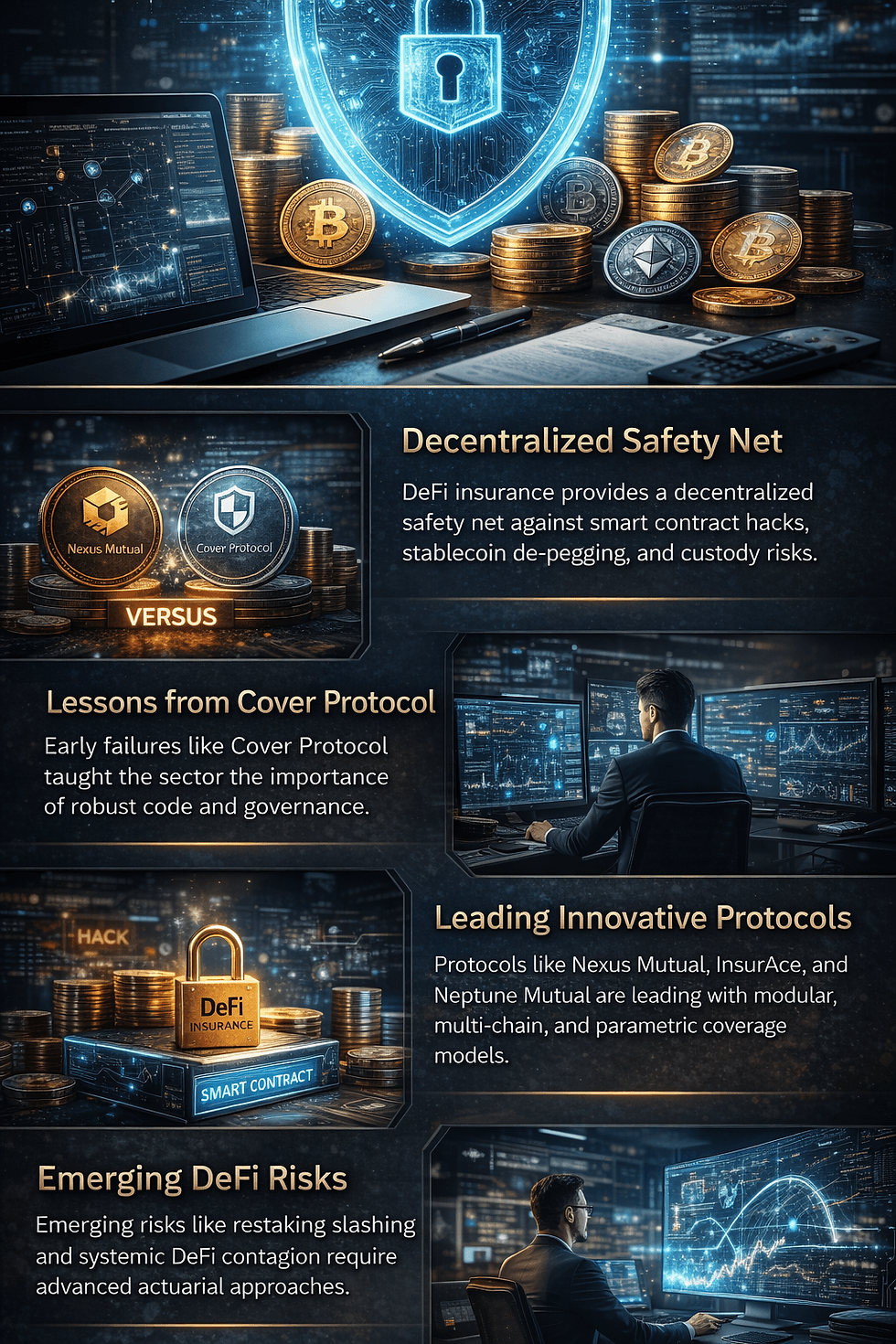
Early failures like Cover Protocol taught the sector the importance of robust code and governance.
Leading protocols like Nexus Mutual, InsurAce, and Neptune Mutual are innovating with modular, multi-chain, and parametric coverage models.
Emerging risks like restaking slashing and systemic DeFi contagion require advanced actuarial approaches.
The sector is moving toward seamless wallet integrations and AI-driven dynamic pricing for real-time risk management.
DeFi Insurance: Key Insights and Risk Management Overview
DeFi insurance is rapidly becoming an essential tool for anyone navigating the crypto landscape. By providing financial protection against hacks, protocol failures, and market anomalies, it allows investors to engage with confidence. As the ecosystem grows, these insurance protocols are not only safeguarding assets but also driving innovation in risk assessment, automated claims, and cross-chain coverage, setting new standards for security in decentralized finance.
The Evolution of the Safety Net: From Chaos to Cover
To understand the revolution, we must first look at how traditional insurance operates.
In TradFi, you pay a premium to a massive, centralized corporation. That corporation pools your money with millions of others, invests it, and (ideally) pays out if you file a valid claim. The entire process is opaque. You have no idea how much capital the insurer actually holds, and claim denials are notoriously frustrating.
DeFi insurance flips this model on its head. It is entirely peer-to-peer. It is completely transparent on the blockchain.
Instead of a faceless corporation taking your premium, everyday crypto users provide the capital. These "liquidity providers" lock their funds into a smart contract pool to earn a yield. When a user wants to buy coverage for a specific protocol (like Aave or Uniswap), they pay a premium directly into this pool. If a hack occurs, the protocol’s community votes on the validity of the claim, and the smart contract automatically disperses the funds.
It is democratic risk management. But getting here was not a smooth journey.
The Cautionary Tale: Cover Protocol

You cannot discuss the history of DeFi insurance without mentioning Cover Protocol.
Launched in late 2020, Cover Protocol was an incredibly ambitious project. It aimed to allow users to buy coverage on literally anything in the DeFi space using a unique, fungible token model. It was designed to bridge traditional finance and DeFi seamlessly, becoming a darling of the early bull market.
However, Cover Protocol ultimately became a masterclass in the dangers of the very ecosystem it was trying to protect. In December 2020, the protocol suffered a catastrophic "infinite minting" hack. A vulnerability in its own code allowed an attacker to print unlimited tokens, wiping out over 90% of its value in hours. While a white-hat hacker eventually returned the stolen funds, the damage to its reputation was fatal. By late 2021, after core developers abruptly abandoned the project, Cover Protocol officially shut down.
Cover Protocol's demise taught the industry a brutal but necessary lesson. Innovation cannot outpace security. An insurance protocol must be structurally sound, mathematically un-gameable, and fiercely audited.
The Enduring King: Nexus Mutual
While Cover Protocol fell, Nexus Mutual thrived. Nexus Mutual has expanded its cover offerings to include custody and yield token protections, securing assets for DeFi users on and off‑chain.
Launched in 2019, Nexus Mutual took a much more methodical, cautious approach. Built on Ethereum, it operates as a true digital cooperative. Members pool capital, share risk, and vote on claims using the native NXM token. By sticking to a strict Minimum Capital Requirement (MCR) and slowly, carefully expanding its coverage offerings, Nexus Mutual survived the brutal bear markets and the catastrophic industry hacks of the early 2020s.
Today, in 2026, Nexus Mutual remains the undisputed heavyweight champion of the sector, protecting billions of dollars and constantly evolving its architecture to meet the market's rapidly shifting needs.
Innovating the Shield: What Exactly Are We Insuring?

The threats in the crypto space are constantly evolving. Hackers get smarter. Economic models grow more complex. To keep up, DeFi insurance protocols have aggressively expanded their coverage options.
Here is exactly how these platforms are revolutionizing risk management across four critical vectors.
1. Smart Contract Vulnerabilities
This is the bread and butter of DeFi insurance.
A smart contract is just code written by humans, and humans make mistakes. If a developer leaves a logic loophole in a decentralized lending protocol, a hacker can exploit it to drain the entire treasury.
Protocols like Nexus Mutual and InsurAce provide direct "Smart Contract Cover." If you deposit $50,000 into a decentralized exchange, you can buy a policy specifically covering that exchange's contract address. If the contract is breached and you lose at least 20% of your funds due to an unintended use of the code, the insurance pool makes you whole. This coverage is the ultimate peace of mind for yield farmers moving massive sums of capital.
The historic collapse of Terra's UST algorithmic stablecoin wiped out tens of billions of dollars. It proved that "stable" is a very relative term in crypto.
Modern DeFi insurance has introduced robust de-peg coverage. If you hold a massive corporate treasury in USDC or USDS, you can purchase insurance against the asset losing its 1:1 parity with the US Dollar.
The collapse of the TerraUSD stablecoin triggered a massive market downturn and renewed regulatory scrutiny of algorithmic stablecoins.
Furthermore, protocols are deploying "parametric" insurance for price crashes. Parametric insurance is a technological game-changer. Instead of relying on a community vote to approve a claim, the smart contract relies strictly on an external data feed (an Oracle). If the Oracle reports that the price of a specific stablecoin drops below $0.90 for a sustained period, the smart contract automatically and instantly triggers the payout. There is no human intervention. There is no agonizing waiting period.
3. Liquidity and Custody Risks
Not all crypto risks happen directly on-chain. Millions of users still rely on centralized exchanges (like Binance or Kraken) and centralized lending institutions.
If a centralized exchange goes bankrupt or pauses withdrawals indefinitely, traditional DeFi smart contract cover will not help you. To bridge this gap, decentralized insurance providers introduced "Custody Cover." This allows users to hedge against the catastrophic failure of centralized entities. If an exchange halts withdrawals for over 90 days, or suffers a severe custodial hack, the decentralized pool pays out the affected users.
4. The 2026 Frontier: Restaking and Slashing Risks
As Ethereum evolved its Proof-of-Stake consensus, a massive new primitive emerged: Restaking.
Platforms like EigenLayer and Symbiotic allow users to take their staked ETH and "re-stake" it to secure other secondary networks. This generates massive, compounded yields, but it introduces "slashing risk." If the secondary network makes an error, your underlying ETH can be slashed (destroyed) as an algorithmic penalty.
In a groundbreaking move for 2026, Nexus Mutual actively integrated with restaking platforms. They created custom coverage mandates. Users can now perfectly insure their restaked assets against algorithmic slashing penalties. This singular innovation is allowing institutional capital to aggressively pursue high yields without fearing catastrophic base-layer losses.
The Mechanics of Protection: How the Top Protocols Operate Today
To truly appreciate the revolution, we must look at how the leading protocols actually function under the hood. The technology has matured significantly from the experimental days.
Nexus Mutual V2: The Modular Fortress
Nexus Mutual completely revamped its architecture with its V2 upgrade, transitioning from a monolithic structure into a highly modular system.
Instead of one giant pool of money covering everything, Nexus V2 allows specialized "Syndicates" to form. Risk experts can spin up their own localized insurance pools within the Nexus ecosystem. They can set their own mathematical pricing models, choose exactly which obscure protocols they want to cover, and attract capital based on their specific risk-assessment skills.
This modularity solved a massive operational bottleneck. It decentralized the risk assessment process, allowing the protocol to scale coverage to thousands of new DeFi projects without requiring the entire DAO to vote on every single premium adjustment.
InsurAce: The Multi-Chain Shield
While Nexus Mutual initially focused heavily on Ethereum, DeFi quickly became a sprawling, multi-chain universe. Liquidity exploded across Solana, Base, and Arbitrum.
InsurAce capitalized on this fragmentation by building an aggressive, multi-chain architecture. Users can purchase coverage for over 140 different protocols across 20 different blockchains, all from a single, unified dashboard.
Crucially, InsurAce pioneered portfolio-based coverage. Instead of buying individual policies for every single protocol you interact with, you can buy a blanket policy that covers your entire wallet across multiple decentralized applications. This dramatically lowered the friction for active traders who move funds daily.
Neptune Mutual: The Parametric Pioneers
If you hate waiting for a claims adjuster to decide your fate, you will love Neptune Mutual.
Neptune focuses entirely on parametric cover models. They absolutely refuse to rely on subjective community voting to decide if a hack was "unintended" or a "user error." They define strict, binary parameters encoded directly into the blockchain.
Did a specific smart contract address get drained of more than 50% of its TVL within a 2-hour window? If the blockchain data says yes, the payout is triggered automatically. This eliminates the lengthy deliberation process and guarantees that victims receive their financial compensation exactly when they need it most—immediately after a crisis.
The Vulnerabilities in the Armor: Challenges Facing DeFi Insurance
Despite the massive technological leaps, decentralized insurance is not a flawless system. The sector faces significant headwinds that threaten to slow its projected growth.
Industry research shows that despite growing adoption, decentralized insurance still covers only a fraction of total DeFi value locked, indicating room for sector expansion.
1. The Crisis of Capital Efficiency
The greatest challenge facing any insurance fund is what to do with the money while waiting for a disaster.
If an insurance protocol holds $200 million in an idle smart contract, that capital is wasting away. Liquidity providers want yield. If they can earn 8% by lending their stablecoins on Aave, why would they lock them in an insurance pool for only 4%?
To solve this, protocols are aggressively deploying "Risk-Aware Capital." Instead of sitting idle, the treasury funds are routed into ultra-safe, yield-generating DeFi protocols. However, the challenge is balancing this appropriately. If you invest the insurance treasury into a protocol that gets hacked, you lose the very funds meant to protect users from hacks. It is a delicate, high-stakes balancing act.
2. The Oracle Problem
Parametric insurance relies entirely on Oracles (data feeds like Chainlink) to trigger payouts.
But what happens if the Oracle itself is manipulated? If a malicious actor successfully tricks an Oracle into reporting that a stablecoin has de-pegged, they could trigger a massive, illegitimate payout from the insurance pool. The entire system is only as secure as the data feeding it.
Ensuring that these data feeds are decentralized, tamper-proof, and resilient to flash-loan attacks remains a constant engineering struggle for developers.
3. Regulatory Uncertainty
Traditional insurance is one of the most heavily regulated industries on the planet. Governments require strict KYC (Know Your Customer) checks, massive fiat reserves, and endless licensing.
DeFi insurance operates in a regulatory gray area. By using terms like "mutual," "discretionary cover," and "capital pools," protocols attempt to distance themselves from the strict legal definition of an insurance company. However, as these platforms begin covering real-world assets and traditional retail businesses, global regulatory agencies are paying close attention. Bridging the gap between permissionless crypto rails and strict international financial compliance is the defining legal battle of 2026.
4. Correlated Risk and Systemic Contagion
In traditional insurance, if a hurricane hits Florida, it doesn't cause a tsunami in Japan. The risks are geographically isolated.
DeFi, however, is deeply and inextricably interconnected. A bug in a core Ethereum infrastructure project (like a massive liquid staking token) could simultaneously crash lending markets, decentralized exchanges, and algorithmic stablecoins. If a single foundational exploit triggers claims across fifty different protocols at the exact same time, it could completely bankrupt a decentralized insurance provider. Modeling and pricing this systemic, correlated risk is exceptionally difficult.
The Future: Where Does DeFi Risk Management Go From Here?
The demand for on-chain security is insatiable. As we look toward the remainder of the decade, the DeFi insurance sector is poised for a massive evolutionary leap.
Natively Integrated Coverage
Currently, buying DeFi insurance is a clunky, secondary action. You deposit money into an application, and then you must navigate to a completely separate platform like Nexus Mutual to buy a policy.
The future is seamless integration. We are already seeing the first waves of native wallet integrations. Soon, when you execute a transaction on a decentralized exchange, a small checkbox will appear natively in your MetaMask or Coinbase Wallet: "Add Smart Contract Cover for 0.05%." By embedding the insurance premium directly into the transaction route, protocols will capture massive volume from everyday users who prioritize convenience over complexity.
AI-Driven Actuarial Models
Pricing risk accurately is the hardest part of insurance. Currently, pricing is driven by simple supply and demand metrics within the capital pools.
In the near future, we will see the integration of Artificial Intelligence into the underwriting process. Specialized AI agents will constantly scan the source code of decentralized applications, monitor the real-time flow of liquidity, and analyze the historical behavior of the developers. Based on this massive dataset, the AI will dynamically adjust the insurance premiums block-by-block, creating a hyper-efficient, continuously updating risk market.
The Ultimate Symbiosis
DeFi insurance is no longer a niche sub-sector for paranoid crypto traders. It is the foundational layer required for the mass institutional adoption of cryptocurrency.
Wall Street banks, massive pension funds, and sovereign wealth funds will never blindly trust decentralized code. They absolutely require mathematical guarantees. They require formalized risk transfer. Decentralized insurance protocols are providing the exact infrastructure necessary to safely onboard the next trillion dollars into the digital economy.
By transforming passive crypto capital into intelligent, risk-aware defense systems, platforms like Nexus Mutual and InsurAce are doing much more than just paying out claims. They are legitimizing the entire blockchain experiment. They are actively proving that a decentralized community can out-perform, out-price, and out-innovate the legacy insurance corporations of the past.
Summary!
DeFi Insurance is more than a safety net—it’s the backbone of trust in a borderless, decentralized financial world. As the ecosystem grows, these protocols are not just mitigating risks but actively shaping the future of finance, proving that transparency, community governance, and innovation can rival even the most established legacy institutions.
The evolution of insurance in crypto signals a shift: risk is no longer a barrier to participation; it’s a space for ingenuity, collaboration, and unstoppable growth.
For regular updates on DeFi Insurance and the latest developments in crypto risk management, bookmark BitCoinBlog and stay informed. You will get actionable insights and expert analyses that help you navigate the decentralized finance frontier.

AUTHOR
Jan Matula
Graduate of EUBA University, experienced Forex and Stocks trader since 2008, early Bitcoin investor and crypto trader since 2021.
This content is for informational purposes only and should not be taken as solicitation, recommendation, endorsement or investment advice. It is crucial for you to conduct your own research and due diligence to make informed decisions, as any investment will be your sole responsibility. Please review our disclaimer and risk warning.