Hyperliquid Decentralized Crypto Exchange (DEX). A new era of high-performance DeFi
The End of Compromise
For the past five years, crypto traders have been frustrated by the "trilemma of exchange." They could choose speed (centralized exchanges like Binance), self-custody (AMMs like Uniswap), or complexity (layer 2 solutions). But you could never have all three.
If you wanted the lightning-fast execution of a centralized order book, you had to surrender your private keys and trust that the exchange wouldn't misuse your funds—a trust shattered by the collapse of FTX. Conversely, if you demanded self-custody, you had to accept the high latency, slippage, and gas fees inherent to on-chain trading.
Hyperliquid has emerged as the definitive solution to this compromise. It's not just another decentralized exchange (DEX); it's a whole new way of building financial infrastructure. Hyperliquid developed a purpose-built Layer 1 blockchain dedicated solely to trading. This allows Hyperliquid to deliver the performance of a centralized giant like Bybit within a permissionless, non-custodial environment.
Hyperliquid Decentralized Crypto Exchange (DEX): The Architecture of Speed
To understand Hyperliquid’s dominance, one must first understand the limitations of general-purpose blockchains.
Networks like Ethereum, Arbitrum, and Solana are designed for "general computing." These shared environments force high-frequency trading algorithms to compete with NFT mints, gaming transactions, and social media apps for block space. This creates a "noisy neighbor" problem: when the network becomes overloaded due to a popular token launch, trading latency spikes and fees skyrocket — precisely when traders need speed the most.
Hyperliquid solves this problem by operating as an AppChain, which is a blockchain built for one specific purpose: a high-performance central limit order book (CLOB).

Figure 1: The “Noisy Neighbor” Problem vs. AppChain Isolation. On general-purpose blockchains (left), trading transactions compete with NFTs and gaming for block space. Hyperliquid’s dedicated L1 (right) provides an unobstructed lane for high-frequency trading.
HyperBFT and the “<0.2s” Standard
Hyperliquid's custom consensus mechanism, HyperBFT, is the backbone of the network. Inspired by HotStuff, HyperBFT allows the network to reach consensus and finalize transactions in under 0.2 seconds.
This is a critical distinction. In Optimistic Rollups, such as Arbitrum or Base, "finality" is a complex term that often involves a seven-day fraud-proof window. On Hyperliquid, finality is nearly instantaneous. This speed is non-negotiable for market makers because it enables them to update quotes hundreds of times per second. The result is tighter spreads and deeper liquidity for the end user.
Fully On-Chain Logic
Unlike competitors such as dYdX v3, which matched orders off-chain and settled on-chain, Hyperliquid runs its entire matching engine on-chain. Every order placed, canceled, or filled is a transaction that is recorded on the ledger. This ensures absolute transparency; there is no "black box" in which an exchange operator could front-run users or prioritize their own internal desk.

Figure 2: Beyond the “Black Box”. Unlike hybrid exchanges that process orders off-chain, Hyperliquid records every order, cancellation, and trade execution directly on the ledger, ensuring immutable transparency.
The Frictionless Experience: “Gas-Free” and Session Keys
A poor user experience (UX) renders technological superiority irrelevant. Hyperliquid has managed to eliminate the cumbersome aspects of Web3, rendering the platform indistinguishable from a Web2 application.
The Death of Gas Fees
On most DEXs, every action incurs a fee. For example, modifying a limit order on a standard Layer 2 could cost between $0.10 and $0.50. For an active trader, these costs can destroy profitability.
Hyperliquid operates on a zero-gas model for trading. The protocol subsidizes gas fees for all order-related transactions. Traders can place and cancel thousands of orders per day without spending anything on network fees. This economic model aligns perfectly with the behavior of liquidity providers and high-frequency traders.
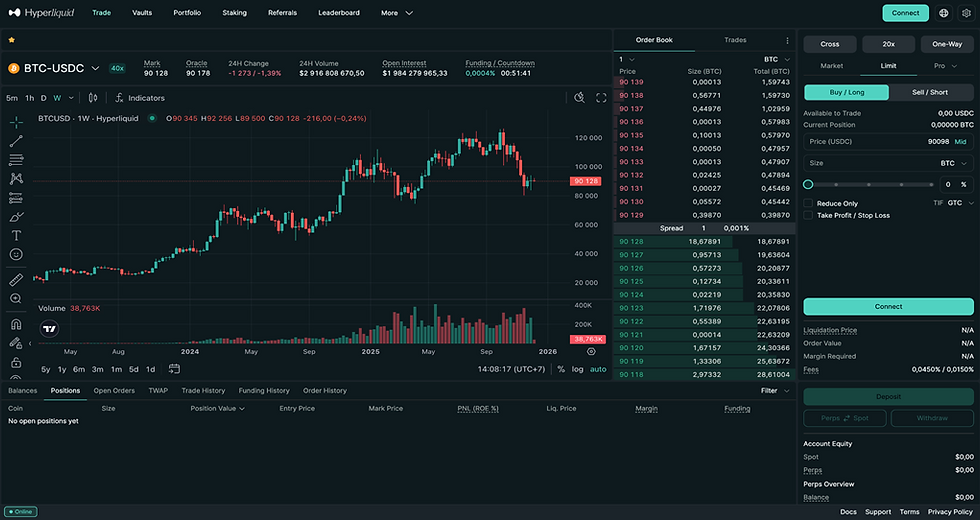
Figure 3: CEX-like Experience in DeFi. The Hyperliquid interface mirrors standard professional trading terminals. Thanks to “Session Keys”, traders enjoy one-click execution without confirming every transaction in their wallet.
Session Keys (API Wallets)
The most jarring aspect of DeFi is usually the pop-up wallet signature request that appears with each interaction. Hyperliquid uses session keys. When a user connects, they sign one transaction to authorize a temporary session. This allows the browser to sign orders in the background for a set period. The result is a "one-click" trading experience that rivals Binance's fluidity. Meanwhile, the session key itself is restricted; it can only be used for trading, not for withdrawing funds, thus maintaining security.
HyperEVM: The Frontier of Atomic Composability
Although the core exchange is built on Rust for optimal performance, Hyperliquid recently introduced its most ambitious feature: HyperEVM.
HyperEVM is a high-performance implementation of the Ethereum Virtual Machine that runs directly on Hyperliquid's L1 blockchain. It allows developers to deploy standard Solidity smart contracts that can interact natively with the exchange’s liquidity.

Figure 4: Visualizing Atomic Composability. The HyperEVM allows distinct financial primitives — like lending, trading, and rebalancing — to snap together and execute within a single atomic transaction.
This unlocks atomic composability. In other ecosystems, creating a yield vault on a DEX typically requires complex cross-chain bridging or asynchronous calls. Hyperliquid's smart contracts can read the order book, execute trades, manage collateral, and rebalance portfolios — all within a single, atomic transaction.
This infrastructure is giving rise to a new generation of financial products.
● Delta-Neutral Yield Vaults: These are automated strategies that earn funding rates by hedging spot assets against perpetual shorts.
● On-chain hedge funds: Transparent asset management protocols in which depositors can verify strategy execution in real time.
● Algorithmic Execution: Decentralized TWAP (time-weighted average price) and grid trading bots that run trustlessly on the blockchain.
The Ecosystem: Beyond Perpetuals
Hyperliquid has successfully evolved from a "niche perpetual DEX" into a comprehensive financial ecosystem.
Spot Trading and HIP-1 Assets
The platform introduced spot trading for native tokens using the HIP-1 standard. This effectively transforms Hyperliquid into a launchpad for new projects. Unlike ERC-20 tokens on Ethereum, HIP-1 tokens utilize the same high-speed matching engine. This enables a thriving ecosystem of memecoins and utility tokens that can trade with the liquidity of a centralized venue.
The HLP (Hyperliquidity Provider)
Liquidity is the lifeblood of any exchange. Hyperliquid solves the "cold start" problem with the HLP Vault. Unlike a standard liquidity pool, where users deposit two assets (as they do on Uniswap), the HLP Vault is where users deposit USDC.

Figure 5: The HLP Flywheel. Users deposit USDC into the HLP Vault, which acts as the counterparty to traders. The yield is generated from real trading activity: spreads, fees, and trader PnL (Profit and Loss).
The protocol uses this capital to implement automated market-making strategies on the order book. Depositors essentially become "the house," earning a share of the PnL from market making and liquidations. While there is risk involved, as the house could lose money in the short term, this method has historically provided a robust yield, democratizing market-making profits that were previously reserved for institutional firms.
Risk Analysis: Trust, but verify!
Despite its innovative architecture, Hyperliquid is not risk-free. Any sophisticated user must understand its potential failure points.
Bridge Risk: Hyperliquid does not natively connect to fiat banking systems. It uses an Arbitrum bridge (and, by extension, an Ethereum bridge) to onboard USDC. While the bridge has functioned perfectly thus far, cross-chain bridges are historically the most vulnerable component in DeFi. If the Arbitrum bridge were to fail, funds on Hyperliquid L1 could become inaccessible.
L1 Centralization: Hyperliquid is a relatively new blockchain, so its set of validators is smaller and more concentrated than Ethereum's. The ultimate goal is progressive decentralization; however, the network currently relies on a smaller group of operators to maintain consensus.
Execution Risk: Although HyperBFT is fast, blockchain networks can stall. In a scenario of extreme market volatility, on-chain liquidations might not trigger instantly if the chain were to halt or lag. This could result in bad debt for the protocol, though the insurance fund is designed to mitigate this scenario.
Good to know!
Wundertrading has an exclusive offer for Hyperliquid users, providing them with a complimentary Premium plan that unlocks a wealth of powerful automated trading tools and features designed to enhance their trading experience. This is an exceptional opportunity for users to leverage automated trading strategies completely for free.
As part of the Premium plan, users will have access to an impressive array of trading bots:
Unlimited Active Signal Bots
5 Active Market Neutral Bots
200 Active Grid Bots
300 Active DCA Bots
Multi-API Access (Max. 50 APIs)
AI Bot
Conclusion: The New Standard

Figure 6: Competitive Landscape. A technical comparison highlighting Hyperliquid’s architectural advantages over dYdX v4, GMX, and centralized exchanges like Binance.
Hyperliquid marks the maturation of the decentralized finance industry. We are transitioning from an era of slow, expensive, and difficult-to-use "DeFi toys" to an era of high-performance financial infrastructure.
Hyperliquid eliminates the friction that kept institutional capital at bay by integrating the blockchain, consensus mechanism, and exchange application vertically. Hyperliquid offers the speed and depth of a centralized exchange with the uncompromising security of self-custody.
As the crypto market heads toward its next cycle, the winners will be the platforms that can handle mass adoption without crashing. Hyperliquid has built more than a better DEX—it has built a better way to trade. For the first time, compromise is unnecessary.

AUTHOR
Jan Matula
Graduate of EUBA University, experienced Forex and Stocks trader since 2008, early Bitcoin investor and crypto trader since 2021.
This content is for informational purposes only and should not be taken as solicitation, recommendation, endorsement or investment advice. It is crucial for you to conduct your own research and due diligence to make informed decisions, as any investment will be your sole responsibility. Please review our disclaimer and risk warning