
Mastering Crypto Trading Order Books, Liquidity, and Slippage: A Comprehensive Guide
Updated: Aug 11
TABLE OF CONTENT
Crypto trading is a fast-growing market with millions of participants worldwide. Success requires more than choosing popular coins. Traders must understand how trades are executed. Order books, liquidity, and slippage play a key role in price movement and trade outcomes. Order books show real-time buy and sell orders. They reveal market supply and demand at different price levels.
Liquidity determines if trades can happen smoothly without large price changes. Low liquidity can increase volatility and risk. Slippage occurs when the price at execution differs from the expected price. It often happens during high volatility or large trades. Understanding these factors helps traders make better decisions. It reduces risk and improves performance.
This guide explores crypto trading order books, liquidity, and slippage. It provides strategies and insights that traders can apply to improve their results in the crypto market.
Key Highlights
Understanding order books is essential for gauging real-time market supply and demand in crypto trading.
Liquidity determines trade execution efficiency and impacts price stability during market moves.
Slippage occurs when executed prices differ from expected prices and can reduce trading profits.
Analyzing order book depth and volume helps anticipate price movements and identify support or resistance levels.
Strategic use of limit orders, trade sizing, and timing reduces risk and improves overall trading performance.
Why Understanding Crypto Trading Order Books is Essential for Every Trader

Order books form the backbone of every crypto exchange. They provide a detailed list of all active buy and sell orders for a cryptocurrency. Each entry shows the price level and the quantity that traders want to transact. Understanding order books allows traders to gauge market sentiment in real time. It shows where buyers are strong and where sellers are active.
This information helps traders anticipate short-term price moves. It also assists in planning entries, exits, and risk management strategies. Traders who ignore order books often face unexpected price changes and higher trading costs.
By learning to read order books, traders gain a significant advantage over those relying solely on charts or news.
How Order Books Reflect Market Supply and Demand
Order books provide a continuous snapshot of market supply and demand. Buy orders, or bids, indicate where traders are willing to purchase an asset. Sell orders, or asks, show where traders are willing to sell. When the total demand surpasses supply, upward price movement is likely. Conversely, when supply exceeds demand, downward pressure emerges.
Traders can watch shifts in order sizes to detect potential price trends before they appear on the chart. Large buy clusters may signal strong support, while large sell clusters indicate resistance. Recognizing these patterns allows traders to anticipate market behavior and make more informed decisions.
1) Difference Between Bids and Asks
Bids are the highest prices that buyers are willing to pay for an asset. Asks are the lowest prices that sellers will accept. The difference between these two values is known as the spread. A narrow spread suggests a liquid market where trades can occur with minimal price disruption. A wide spread indicates lower liquidity, meaning trades can significantly impact price.
Monitoring bid and ask levels provides insight into short-term market pressure. Traders can determine whether buyers or sellers currently dominate the market and adjust their strategies accordingly.
2) The Role of Order Size in Price Movement
Order size significantly affects price action. Large buy orders can drive prices higher as they absorb available sell orders. Similarly, large sell orders can push prices down by consuming buy orders. Traders often watch for “walls,” which are clusters of large buy or sell orders placed at a specific price level. These walls act as temporary support or resistance, preventing price from moving easily past that level.
Identifying walls and unusual order sizes helps traders forecast potential reversals or breakouts. It also provides insight into institutional activity that may influence market trends.
How Market Orders Interact with Limit Orders
Market orders execute immediately at the best available price in the order book. When a market order is placed, it consumes existing limit orders on the opposite side. Limit orders are pending orders placed at specific prices and remain in the book until matched. Understanding this interaction is crucial for predicting short-term price changes. It also helps traders minimize slippage, which occurs when the executed price differs from the expected price.
By observing how market and limit orders interact, traders can time trades better and reduce unexpected costs.
How to Analyze an Order Book to Make Smarter Trades

Analyzing an order book is essential for executing trades strategically. A careful review provides insight into market behavior, supply and demand imbalances, and potential price movements. Traders who can interpret order books effectively gain an edge in timing entries and exits.
1) Reading the Best Bid and Ask Prices
The best bid is the highest price a buyer is willing to pay. The best ask is the lowest price a seller will accept. These prices form the current market rate for a cryptocurrency. Monitoring them helps traders understand short-term price trends. Sudden shifts in the best bid or ask can indicate immediate buying or selling pressure. Traders can act on these signals to enter or exit positions efficiently.
2) Identifying Buy and Sell Walls
Buy and sell walls are large clusters of orders at specific price levels. A buy wall shows strong demand, potentially supporting the price. A sell wall represents heavy supply, which may prevent the price from rising. Detecting these walls allows traders to anticipate resistance and support zones. Walls can also reveal the intentions of large market participants.
3) Understanding Market Depth Charts
Market depth charts visually represent the cumulative volume of bids and asks at each price level. They help traders quickly assess liquidity and identify imbalances. A steep bid curve indicates strong buying interest, while a steep ask curve shows selling pressure. Depth charts make it easier to visualize potential price movements and determine how much the market can absorb before a price shift occurs.
4) Detecting Imbalances That Indicate Price Shifts
Imbalances occur when one side of the order book dominates the other. For example, if buy orders far exceed sell orders, upward price movement is likely. Conversely, excess sell orders can signal downward pressure. Traders monitor these imbalances to anticipate short-term price swings. Recognizing them early provides opportunities for timely trades and risk management.
How Liquidity Shapes the Way Trades Are Executed in Crypto
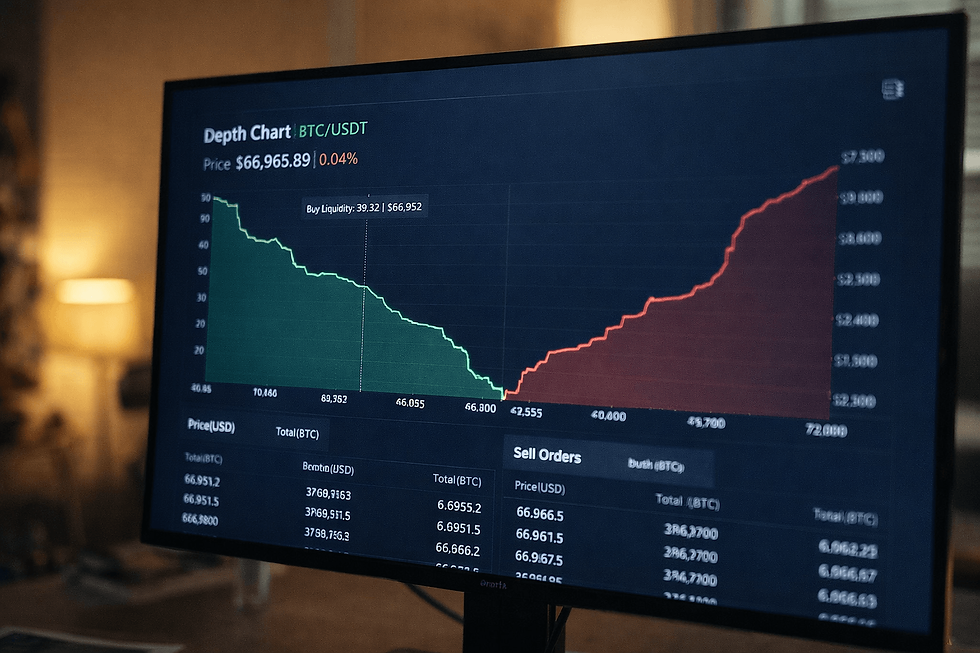
Liquidity is a critical factor in crypto trading. It determines how easily an asset can be bought or sold without affecting its price. High liquidity allows trades to execute quickly at expected prices. Low liquidity can lead to volatility and larger price swings. Understanding liquidity helps traders plan their strategy and manage risk effectively.
1) What Liquidity Means and Why It Matters
Liquidity refers to the availability of buy and sell orders in a market. A highly liquid market has many active participants on both sides. Trades can be executed in large volumes with minimal price impact. Low liquidity markets may have fewer orders, causing prices to move sharply when large trades occur. Assessing liquidity helps traders avoid unexpected slippage and ensures smoother trade execution.
2) High vs. Low Liquidity Scenarios
In high liquidity scenarios, market orders are filled almost instantly at prices close to the expected value. Spreads between bids and asks are usually narrow, reducing trading costs. In low liquidity scenarios, even small trades can move the market. Spreads widen, and slippage risk increases. Traders must adjust their order sizes and timing to avoid adverse price effects.
3) How Order Book Volume Affects Price Stability
The total volume of buy and sell orders at different price levels directly affects price stability. Large order books with balanced bids and asks absorb market shocks better. Shallow order books with limited volume can amplify price movements from relatively small trades. Monitoring order book volume helps traders anticipate volatility and protect capital.
4) Using Liquidity Metrics to Time Your Trades
Traders use metrics such as trading volume, order book depth, and bid-ask spreads to gauge liquidity. Timing trades during periods of high liquidity minimizes slippage and reduces execution risk. Conversely, executing trades in low liquidity periods may result in unexpected price impact. Properly analyzing liquidity metrics allows traders to optimize trade timing and improve overall efficiency.
What Causes Slippage and How to Protect Your Trades Against It

Slippage is a common challenge in crypto trading. It occurs when the executed price of a trade differs from the expected price. Slippage can reduce profits or increase losses. Understanding its causes is essential for effective trade planning and risk management.
1) Why Slippage Happens in Crypto Markets
Slippage happens when there is insufficient liquidity to fill an order at the desired price. High volatility can also contribute. In fast-moving markets, prices may change between the moment an order is placed and executed. Market orders are particularly susceptible because they fill immediately at the best available prices.
2) Positive and Negative Slippage Explained
Positive slippage occurs when a trade executes at a better price than expected. For example, a buy order fills below the intended price. Negative slippage happens when a trade fills at a worse price than intended. Both types affect overall trading outcomes, but negative slippage is more concerning as it increases costs or losses.
3) Trading Scenarios That Increase Slippage Risk
Large trades in low liquidity markets are highly prone to slippage. Sudden news events or price spikes also increase risk. Traders using market orders without monitoring order book depth face higher chances of adverse price execution. Recognizing high-risk scenarios helps in adjusting strategies accordingly.
4) How Large Orders Can Move the Market
Placing a large market order can consume multiple levels of limit orders in the book. This pushes the price up for buys or down for sells. Traders often break large trades into smaller portions to reduce market impact. Understanding the interaction between order size and market depth is key to minimizing slippage and protecting capital.
How Order Book Depth, Liquidity, and Slippage Work Together

Understanding how order book depth, liquidity, and slippage interact is vital for executing trades effectively. These factors are interconnected. Each directly influences price movement and trade outcomes. Traders who consider them together can make better decisions and minimize risks.
1) Deep Order Book
A deep order book has a large number of buy and sell orders distributed across many price levels. This depth allows the market to absorb substantial trades without causing major price changes. Traders placing orders in a deep market experience less slippage because there are enough counter-orders to fill trades at expected prices. Deep books also signal a liquid and stable market. They reduce sudden volatility and make it easier for traders to enter or exit positions with confidence. Observing depth patterns helps identify strong support and resistance levels, providing actionable information for strategic trade planning.
2) Shallow Liquidity
Shallow liquidity exists when order book volumes are small or concentrated at limited price points. In such markets, even moderately sized trades can move prices sharply. Low liquidity increases the likelihood of negative slippage and unexpected market impact. Traders executing large orders in shallow markets risk paying higher prices for buys or receiving less for sells. Monitoring liquidity levels allows traders to adjust order sizes or wait for more favorable conditions. It also highlights periods when the market is vulnerable to volatility.
3) Price Impact
Price impact measures how much a trade changes the market price. Large trades in low liquidity or shallow order books can significantly shift prices. Understanding this interaction allows traders to plan trades that minimize disruption. Breaking a large trade into smaller segments is a common tactic to reduce price impact. Tracking order book volume at different price levels also helps traders estimate how much the market can absorb before significant slippage occurs.
4) Detecting Market Manipulation
Market manipulation can appear as unusual order book activity. Examples include spoofing, where large orders are placed to mislead traders but removed before execution, or fake walls to create the illusion of supply or demand. By combining insights from order book depth and liquidity, traders can detect suspicious activity early. Recognizing manipulation helps avoid traps that could cause losses or distort market signals.
5) Combining Insights
Integrating order book depth, liquidity, and slippage analysis provides a holistic view of market conditions. Traders can better predict short-term price movements, time trades efficiently, and optimize order sizes. This combined approach reduces execution risk and improves overall trading performance. By continuously monitoring these factors, traders gain a competitive advantage in managing both volatility and liquidity challenges.
How to Execute Trades More Efficiently Using Order Book Knowledge
Using order book insights is crucial for executing trades efficiently. Traders who understand the relationship between order book depth, liquidity, and slippage gain a significant edge. This knowledge helps reduce trading costs, avoid unexpected price impact, and optimize both entry and exit points. Consistently applying order book analysis allows for smarter trade timing and better risk management.
1) Market vs. Limit Orders
Market orders execute immediately at the best available price in the order book. They are ideal when speed is critical, but they are prone to slippage, especially in low liquidity or volatile markets. Limit orders, in contrast, specify the price at which a trader is willing to buy or sell. They provide price control and reduce slippage risk but may not execute immediately if the market does not reach the specified level. Understanding when to use market versus limit orders allows traders to balance speed and cost, optimizing their trading strategy.
2) Breaking Large Trades
Large trades can significantly move market prices if executed as a single order. This is particularly true in shallow markets with low liquidity. Splitting large trades into smaller portions, known as order slicing, helps reduce market impact. Traders can place multiple smaller orders at different price levels or intervals. This method minimizes slippage and prevents the market from reacting strongly to a single large order. Breaking trades also provides better control over execution and allows traders to adjust based on evolving market conditions.
3) Timing Trades During Peak Liquidity
Liquidity levels vary throughout the day, often influenced by global market activity and exchange-specific volumes. Executing trades during peak liquidity periods ensures that there are sufficient buy and sell orders to fill trades without large price movements. Monitoring order book activity, trading volume, and bid-ask spreads helps identify these windows. Traders who align their trades with high liquidity periods experience lower slippage and more predictable execution prices, which is critical for maximizing profitability.
4) Integrating Order Book Analysis with Price Trends
Combining order book insights with traditional price trend analysis provides a more comprehensive view of the market. For example, observing strong buy walls in the order book near a technical support level reinforces the likelihood of a price rebound. Similarly, large sell walls near resistance levels can confirm potential price ceilings. This integration allows traders to anticipate short-term movements and align trades with both market structure and technical signals. By using order book data alongside price trends, traders can improve timing, reduce risk, and increase the effectiveness of their trading strategies.
Tools and Techniques for Monitoring Order Books and Market Liquidity
Traders rely on a variety of tools to monitor order books and liquidity in real time. Most crypto exchanges provide native order book interfaces that display live bids, asks, and trade volumes. These interfaces allow traders to track changes in supply and demand as they occur. Beyond exchange platforms, specialized analytics services offer deeper insights, including market depth charts, historical order book data, and liquidity metrics across multiple exchanges.
Alerts and notifications can be set up to signal sudden shifts in the order book, such as the appearance or removal of large buy or sell walls. Volume and spread tracking tools help traders identify optimal trading windows and minimize slippage. Combining these tools with a disciplined approach enables traders to make informed decisions, react quickly to market changes, and execute trades more efficiently while reducing risk.
Best Practices for Reducing Risk and Avoiding Common Pitfalls
Effective crypto trading goes beyond choosing assets and predicting price trends. Traders must implement disciplined strategies to manage risk and optimize trade execution. Following best practices reduces losses, prevents unexpected market impact, and improves long-term performance.
1) Avoid Blind Market Orders
Placing market orders without analyzing the order book is risky. In low liquidity or volatile markets, a market order can execute at a much worse price than expected. Traders should always review the current bids, asks, and overall order book depth before executing a market order. Understanding where large orders are positioned helps avoid excessive slippage and ensures trades are executed more predictably.
2) Confirm Liquidity Before Entering Trades
Liquidity is essential for smooth trade execution. Insufficient liquidity can cause significant price movements, even for moderate-sized trades. Before entering a position, traders should confirm that enough buy or sell orders exist to accommodate their trade. Observing order book volume and bid-ask spreads provides a clear picture of liquidity levels. This practice helps reduce unexpected costs and improves overall trade efficiency.
3) Watch Out for Fake Buy/Sell Walls
Market manipulation is common in crypto trading. Fake buy or sell walls are large orders placed to create an illusion of market sentiment but are removed before execution. Traders relying solely on these visible orders risk making poor decisions. By monitoring order book changes and identifying suspicious patterns, traders can avoid being misled and prevent unnecessary losses.
4) Maintain Discipline During Volatile Markets
High volatility can tempt traders to act impulsively. Emotional trading often leads to mistakes, such as chasing prices or entering trades too early. Maintaining discipline involves sticking to predefined strategies, following risk management rules, and keeping trade sizes consistent. Discipline ensures traders are prepared for sudden price swings without compromising capital.
5) Use Limit Orders Strategically
Limit orders provide control over the execution price. By placing buy or sell orders at specific levels, traders can reduce slippage and prevent trades from executing at unfavorable prices. Strategic use of limit orders allows traders to enter or exit positions efficiently while maintaining flexibility in dynamic markets.
6) Break Large Trades Into Smaller Portions
Large trades can significantly impact market prices if executed in a single order. Splitting trades into smaller portions, or “order slicing,” helps reduce market impact. This approach allows each portion to be executed at better prices and maintains price stability. Traders can monitor execution and adjust subsequent orders based on real-time market conditions.
7) Time Trades During Peak Liquidity
Liquidity fluctuates during the day, influenced by global trading activity and exchange-specific volumes. Executing trades during peak liquidity periods ensures that sufficient buy and sell orders are available. This reduces slippage, improves execution, and minimizes unexpected price movements. Traders who align trades with high-volume periods gain more predictable outcomes and can optimize overall trading performance.
8) Continuous Monitoring and Adjustment
Markets are dynamic, and conditions change rapidly. Traders should continuously monitor order books, spreads, and trading volumes. Adjusting order size, timing, and strategy based on current market conditions helps maintain efficiency. Regular monitoring also enables traders to react quickly to shifts in supply, demand, and liquidity, reducing risks associated with sudden price movements.
By following these best practices, traders can protect capital, reduce slippage, and make more informed decisions. Implementing disciplined strategies ensures consistent execution, improved trade outcomes, and long-term success in crypto trading.
Practical Examples of Using Order Books to Improve Trading Outcomes
Applying order book knowledge can directly improve trading results. Real-world examples illustrate how understanding liquidity, slippage, and order placement leads to better performance.
1) Executing Trades Without Slippage
Analyzing order book depth ensures there is enough liquidity before placing a trade. Traders can use limit orders at optimal price levels to avoid slippage. This approach helps maintain expected entry or exit prices and protects capital.
2) Identifying Altcoins With Sufficient Liquidity
Low-volume cryptocurrencies are prone to large price swings. By examining the order book, traders can identify coins with deep liquidity. Focusing on these assets reduces the risk of adverse price impact and improves trade reliability.
3) Spotting Early Signs of Price Reversals
Changes in bid and ask sizes can indicate potential reversals. A growing buy wall near support may signal an upward move. A strong sell wall near resistance may indicate a downward correction. Recognizing these patterns helps traders anticipate market behavior.
4) Combining Order Book Data With Technical Analysis
Integrating order book insights with chart patterns enhances trade decisions. For example, if a breakout is indicated on the chart and buy volume in the order book increases, traders gain confidence in executing the trade. Conversely, shallow volume warns against overcommitting even during bullish patterns.
5) Timing Trades for Maximum Efficiency
Monitoring order book trends allows traders to execute trades during periods of peak liquidity. This minimizes slippage and ensures trades are filled at expected prices. Proper timing improves overall profitability and reduces risk in volatile markets.
Summary!
So, mastering crypto trading requires a clear understanding of order books, liquidity, and slippage. Each element plays a critical role in how trades are executed and how prices move. Order books provide insight into real-time supply and demand. Liquidity determines whether trades can occur smoothly without large price swings. Slippage measures the difference between expected and executed prices, affecting profitability.
Traders who analyze order book depth and volume can anticipate short-term price movements. They can also identify support and resistance levels and detect unusual market activity. Monitoring liquidity helps optimize trade timing and reduce execution risk. Applying limit orders, breaking large trades into smaller portions, and aligning trades with periods of high liquidity further minimize slippage.
By integrating these strategies, traders can execute crypto trading with greater precision. Consistent analysis and disciplined execution improve efficiency and protect capital. Ultimately, understanding how order books, liquidity, and slippage interact provides a measurable advantage in the competitive crypto market.
For in-depth insights and strategies on crypto trading, explore more articles on BitCoinBlog. Discover expert analysis and actionable tips by visiting BitCoinBlog regularly.

JAN MATULA
Founder of Bitcion.Blog
Graduate of Bratislava University of Economics and Business, experienced Forex and Stocks trader since 2008, early Bitcoin investor and crypto trader since 2021.
This content is for informational purposes only and should not be taken as solicitation, recommendation, endorsement or investment advice. It is crucial for you to conduct your own research and due diligence to make informed decisions, as any investment will be your sole responsibility. Please review our disclaimer and risk warning.
