
What Is Price Correlation and Its Significant Role In Crypto Investments: A Beginner's Guide
Updated: Aug 11
Price correlation is a well-known term for all traders: stock, forex, and also crypto traders. Understanding price correlation is crucial for anyone involved in trading, as it can significantly impact trading strategies and risk management practices. Price correlation refers to the statistical measure that describes the degree to which two financial instruments move in relation to one another over a specified period.
This relationship can be quantified using a correlation coefficient, which ranges from -1 to +1. A correlation of +1 indicates that the two instruments move in perfect unison, meaning that when one instrument rises, the other does as well. Conversely, a correlation of -1 suggests that the two instruments move in opposite directions, where an increase in one results in a decrease in the other. A correlation of 0 indicates no relationship between the price movements of the two instruments.
Simply said, it is how the price movement of two instruments moves in coordination with one another.
This coordination can manifest in various ways, depending on the nature of the instruments involved. For instance, in the stock market, two companies within the same industry may exhibit a high positive correlation due to shared market influences, such as economic conditions or sector performance. In the forex market, currency pairs may correlate based on their economic fundamentals, geopolitical events, or central bank policies.
In the rapidly evolving world of cryptocurrencies, correlations can arise from market sentiment, technological developments, or regulatory news affecting multiple digital assets simultaneously.
This can work with you or against you. If you trade two instruments and you don’t know their correlation, you can expose yourself to double risk, which occurs when both instruments move unfavorably at the same time, leading to compounded losses.
For example, if a trader holds long positions in two highly correlated stocks and the market experiences a downturn, the trader may face significant losses from both positions simultaneously.
On the other hand, understanding correlation can also provide opportunities for hedging. If one instrument can hedge the other one, it means that the price movement of one can offset the risk of the other. For instance, a trader might hold a long position in a stock while simultaneously taking a short position in a correlated stock, effectively reducing potential losses if the market moves against them. This strategic approach can enhance a trader's risk management and overall performance in the market.
In conclusion, grasping the concept of price correlation is essential for traders across all markets. It allows them to make informed decisions about their investments and manage their risks effectively. By analyzing correlations, traders can develop more sophisticated trading strategies that leverage both the opportunities and challenges presented by the interconnected nature of financial instruments.
Price Correlation in Crypto Investments
On the chart below, you can observe a pronounced correlation among major cryptocurrencies, which is an important aspect to consider for any investor looking to navigate the complex landscape of digital assets. This strong correlation indicates that the price movements of these cryptocurrencies tend to follow similar patterns, often reacting to the same market forces or external events. As a result, when one cryptocurrency experiences a significant price increase or decrease, it is likely that others in the same category will follow suit, either positively or negatively.
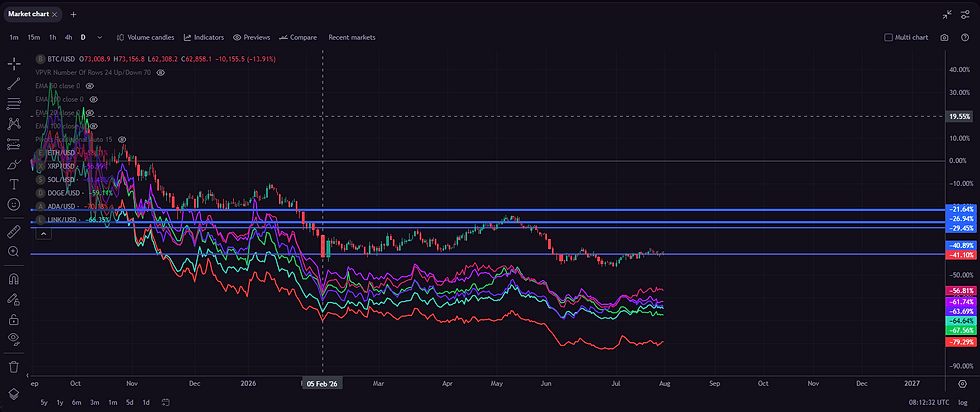
This phenomenon presents a unique challenge for investors aiming to create a balanced and diversified cryptocurrency portfolio. The high correlation makes it more difficult to achieve the desired level of diversification that is typically sought in traditional investment strategies. In traditional asset classes, diversification can help mitigate risk; however, in the realm of cryptocurrencies, the interdependence of these assets means that a downturn in one major cryptocurrency can lead to simultaneous downturns in others, thereby reducing the effectiveness of diversification.
Example
Let's say you plan to invest $1000 in major cryptocurrencies.
You have the option to invest the entire $1000 in one, or you can divide it among major cryptocurrencies. For example, you could allocate $200 to BTC, $200 to ETH, $200 to XRP, $200 to SOL, and $200 to DOGE. This way, you achieve a bit of diversification, which can safeguard you in case of a sudden collapse of one, preventing the loss of your entire $1000.
However, this diversification is not enough to have any kind of balanced portfolio!
To build a balanced crypto portfolio, it is essential to focus on finding cryptocurrencies with low correlation with one another. This principle is grounded in the understanding that diversification is a crucial strategy in investment, particularly in the highly volatile cryptocurrency market. When constructing a crypto portfolio, it is vital to actively seek out cryptocurrencies that do not move in tandem with each other. By doing so, you can significantly mitigate the risks associated with market fluctuations.
Low correlation among the assets in your portfolio means that when one cryptocurrency experiences a decline in value, another may very well be increasing in price. This inverse relationship can help to cushion your overall investment, ensuring that you are not overly exposed to substantial losses at any given time. For instance, if Bitcoin, which is often considered the flagship cryptocurrency, faces a downturn due to market sentiment or regulatory news, a cryptocurrency with low correlation e.g HYPE or ZEC can still perform well, thereby balancing your losses.
Ideally, your portfolio should include a mix of established cryptocurrencies, like Bitcoin and Ethereum, alongside emerging altcoins that serve various purposes within the blockchain ecosystem, such as DeFi projects, NFTs, or stablecoins. This diverse mix can enhance the resilience of your portfolio.
Read more of our articles on this topic:
Conclusion
When considering investments in cryptocurrency, it is crucial to conduct thorough research before making any purchasing decisions.
The correlation between different cryptocurrency charts is an essential factor to examine. Correlation refers to the degree to which two assets move in relation to one another. By analyzing whether the charts of your chosen cryptocurrencies show similar patterns, you can gain valuable insights into their price movements.
By examining correlations, you can enhance your decision-making process and risk management strategies.
In addition to price correlation analysis we recommend to understand also other important practices in crypto investments like reading candle charts, DCA strategy. See our articles on these topics: Mastering Dollar Cost Averaging in Cryptocurrency: A Smart Crypto Dollar-Cost Strategy and

JAN MATULA
Founder of Bitcion.Blog
Graduate of Bratislava University of Economics and Business, experienced Forex and Stocks trader since 2008, early Bitcoin investor and crypto trader since 2021.
This content is for informational purposes only and should not be taken as solicitation, recommendation, endorsement or investment advice. It is crucial for you to conduct your own research and due diligence to make informed decisions, as any investment will be your sole responsibility. Please review our disclaimer and risk warning.


