
What Are Token Unlocks in Crypto? Price Impact Explained
Updated: Aug 11
TABLE OF CONTENT
Token unlocks in crypto are major supply events. They happen when locked tokens become available for transfer, sale, staking, or use. These tokens are often held by teams, early investors, advisors, foundations, or community reward pools.
This topic has become more important in 2026. Many crypto projects launched with only a small part of their supply in the market. The rest is released over months or years. This means the price of a token can face pressure long after launch.
The basic reason is supply. When more tokens enter the market, buyers need to absorb that new supply. If demand is weak, the price may fall. If demand is strong, the market may handle the unlock better.
Research from Keyrock studied more than 16,000 token unlock events. It found that 90% of unlocks created negative price pressure. It also found that price impact often started before the unlock date.
Still, token unlocks in crypto are not automatic sell signals. An unlock does not mean every holder will sell. Some tokens may be held. Some may be used for grants, staking rewards, or project growth.
This guide explains what token unlocks mean. It also explains why tokens are locked, how vesting works, and why unlocks can affect price. It also shows what investors should check before buying a token with a major unlock ahead.
Key Highlights
Token unlocks in crypto release previously locked tokens into the market based on a set vesting schedule.
Large unlocks can increase supply pressure if buyer demand and trading volume are weak.
Unlocks do not always cause price drops because holders may sell, hold, stake, or use the tokens.
Investors should check unlock size, circulating supply, recipient group, FDV, and daily volume before buying.
Token unlock data should be used as a risk signal, not as a guaranteed price prediction.
What Are Token Unlocks in Crypto?

Token unlocks in crypto refer to the release of tokens that were not available earlier. These tokens were locked under a set schedule. Once the unlock happens, the tokens can be moved, sold, staked, or used by the holder.
Most crypto projects do not release all tokens at launch. A project may create 1 billion tokens. But only 100 million or 150 million tokens may enter the market on day one. The rest may stay locked for months or years.
This is common in crypto. Locked tokens may belong to founders, employees, private investors, advisors, the foundation, or reward programs. These groups often receive tokens under a vesting plan. The plan controls when they can access those tokens.
A token unlock is not the same as new token creation. In many cases, the tokens already exist. They are just not free to move. The unlock only changes their status. They become available to the holder.
Token unlocks in crypto are part of tokenomics. Tokenomics shows how a token supply is created and released. It also explains how tokens are shared among different groups. A clear tokenomics plan helps the market understand future supply.
For example, a project may launch with 15% of its supply in circulation. The remaining 85% may unlock over four years. Each future release can change the supply balance.
This is why traders and investors watch unlock dates closely. A token may look scarce at launch. But future unlocks can add more supply to the market. That supply can affect price if demand does not rise at the same time.
Why Are Tokens Locked in the First Place?
Tokens are locked to control supply after launch. This is a common practice in crypto. It helps a project avoid a large supply shock in the early market.
If all tokens were released on day one, the risk would be high. Founders could sell large holdings. Private investors could exit fast. Advisors could also sell before the project has time to grow.
This can hurt trust. It can also cause sharp price moves. For this reason, many projects use lockups and vesting schedules.
1) To Prevent Early Selling
Early selling is one of the main reasons tokens are locked.
Private investors often buy tokens before the public sale. Their entry price may be much lower than the market price after listing. If they can sell at once, they may take profit quickly.
This can create heavy selling pressure. It can also hurt public buyers who entered later. A lockup period reduces this risk.
2) To Align the Team With Long-Term Growth
Team and founder tokens are often locked for a long period. This is done to keep the team involved in the project.
A project may lock team tokens for one year. After that, tokens may unlock each month for three or four years. This setup gives the team a reason to keep building.
It also sends a signal to the market. It shows that the team cannot take full profit right after launch.
3) To Support Future Project Growth
Many projects keep tokens for future use. These tokens may support grants, rewards, staking, liquidity, or new partnerships.
A project may not need all these tokens at launch. So it releases them slowly. This helps the project fund growth over time.
This type of unlock is not always negative. If used well, it can support the network. It can also bring more users and builders into the project.
4) To Give Investors More Clarity
A clear unlock plan gives the market better information. Investors can see when supply may increase. They can also check which group will receive tokens.
This is why token unlocks in crypto are closely tied to trust. A project with unclear supply data may face more doubt. A project with a public vesting plan may be easier to study.
Token locks do not remove risk. But they can make supply changes more predictable. That is why vesting has become a major part of crypto tokenomics.
Learn More: Token Launches, Investors, and Early Allocation
What Is a Crypto Vesting Schedule?

A crypto vesting schedule is a timeline for locked tokens. It shows when tokens will be released. It also shows how many tokens will unlock at each stage.
Vesting is common in crypto projects. It is used for team tokens, investor tokens, advisor tokens, and ecosystem funds. The goal is to stop large holders from getting full access at launch.
A vesting schedule may last for a few months. It may also last for several years. Longer vesting periods are often seen as better for long-term trust. They show that insiders cannot sell all tokens early.
Simple Vesting Example:
Assume a project gives 100 million tokens to its team.
The project may set these terms:
Cliff period: 12 months
Vesting period: 36 months
Unlock style: Monthly release
In this case, the team gets no tokens for the first 12 months. This first waiting period is called a cliff.
After the cliff ends, the team tokens start to unlock each month. The full amount may be released over the next 36 months.
This means the team does not get all 100 million tokens at once. The supply enters the market slowly.
Read More: Understand Token Supply and Vesting
Why Vesting Schedules Matter
Vesting schedules help investors study future supply. They show when locked tokens may become available. They also show which group may receive those tokens.
This is important because future supply can affect price. A project may have a small supply in the market today. But a large number of tokens may unlock later.
Token unlocks in crypto are easier to judge when the vesting plan is clear. A public schedule helps investors see the next unlock date. It also helps them check whether the unlock is small or large.
A weak vesting plan can raise risk. For example, a short lockup for private investors may create fear of early selling. A large team unlock can also worry the market.
A strong vesting plan is usually clear and gradual. It gives the market time to absorb new supply. It also keeps the team and early backers tied to the project for a longer period.
How Do Token Unlocks Work?
Token unlocks in crypto follow a planned process. The process usually starts before a token is launched. The project decides how the total supply will be split. It also decides when each group can access its tokens.
The first step is token allocation. A project may divide supply between the team, investors, advisors, the foundation, the treasury, and the community. Some tokens may also be reserved for staking rewards or ecosystem growth.
The second step is the lockup period. During this period, some tokens cannot be sold or transferred. They stay locked under the project’s vesting plan. This helps control supply in the early market.
The third step is the unlock date. This is the date when locked tokens become available. The unlock may happen once. It may also happen every day, week, month, or quarter.
Once tokens are unlocked, holders can decide what to do with them. They may hold the tokens. They may sell them. They may stake them. They may also use them inside the project’s network.
The final step is the market reaction. This reaction depends on many factors. The size of the unlock matters. The type of holder matters. Market demand also matters.
For example, an unlock for ecosystem rewards may be seen in a different way from an unlock for private investors. Reward tokens may support network use. Investor tokens may raise concern about profit-taking.
Liquidity is also important. If a token has strong daily trading volume, the market may absorb new supply more easily. If trading volume is low, even a medium-sized unlock can create pressure.
This is why token unlocks in crypto should not be viewed in isolation. An unlock is a supply event. But the price effect depends on how the market reacts to that supply.
What are the Main Types of Token Unlocks
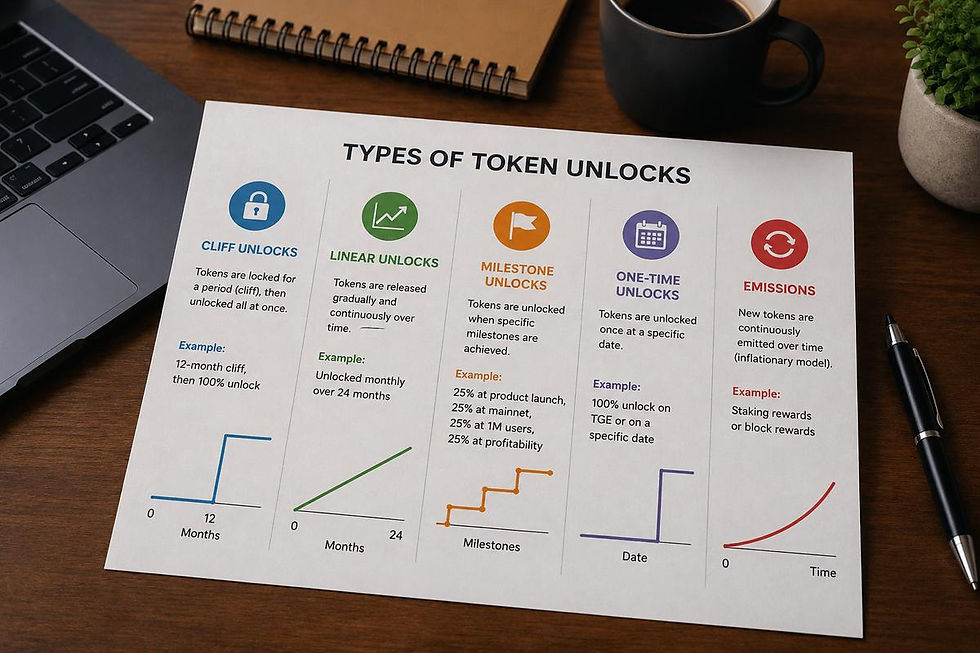
Token unlocks in crypto do not all work in the same way. Some unlocks release a large amount at once. Others release tokens slowly over time.
The type of unlock matters because it can affect market reaction. A sudden release may get more attention from traders. A slow release may be easier for the market to absorb.
1) Cliff Unlocks
A cliff unlock happens after a fixed waiting period. No tokens are released before that date. Once the cliff ends, a large amount of tokens becomes available.
For example, a project may lock investor tokens for 12 months. After 12 months, 20% of those tokens may unlock at once. The rest may unlock later.
Cliff unlocks often get strong market attention. This is because a large supply may become available on a single date.
A cliff unlock does not always lead to selling. But traders may see it as a risk event. This is more likely when the unlock goes to early investors or insiders.
2) Linear Unlocks
Linear unlocks release tokens over time. The release may happen daily, weekly, or monthly.
For example, a project may unlock 10 million tokens every month for 24 months. This creates a steady supply flow.
Linear vesting is often easier to track. It also reduces the risk of one large supply shock. The market can adjust to the new tokens over time.
Still, linear unlocks can also create pressure. This can happen when the release size is large compared with daily trading volume.
3) Milestone-Based Unlocks
Some projects release tokens after certain goals are met. These are called milestone-based unlocks.
For example, tokens may unlock after a mainnet launch. More tokens may unlock after a product release. Some may unlock after the project reaches a user growth target.
This type of unlock links supply release with project progress. It can be useful if the milestones are clear. It may also build trust when the goals are public.
But there is a risk. If the project sets weak goals, the unlock may not mean much. Investors should check whether the milestone has real value.
4) One-Time Unlocks
A one-time unlock releases a fixed amount of tokens on a single date. It may apply to a public sale, airdrop, team grant, or treasury release.
These events are simple to understand. The date and amount are usually known in advance.
A one-time unlock can still affect price. The effect depends on the size of the release. It also depends on who receives the tokens.
5) Continuous Emissions
Continuous emissions are different from normal unlocks. They release tokens on an ongoing basis.
This can happen through staking rewards, mining rewards, liquidity rewards, or ecosystem incentives.
Continuous emissions add supply to the market over time. They may support network activity. But they can also dilute holders if demand does not grow.
This is why investors should study both unlocks and emissions. Both can change the supply of a token. Both can affect price over time.
Who Receives Unlocked Tokens?

Unlocked tokens can go to different groups. This is an important point. Not every unlock has the same market meaning.
A team unlock may be viewed in one way. An investor unlock may be viewed in another way. A community unlock may have a different effect.
The market often checks who receives the tokens before judging the risk.
1) Team and Founders
Team and founder tokens are often locked after launch. These tokens are given to the people who built the project.
A long vesting period can build trust. It shows that the team cannot sell all tokens at once. It also keeps the team tied to the project for a longer time.
But large team unlocks can still worry investors. The market may fear insider selling. This risk is higher when the project has weak growth or poor communication.
2) Early Investors
Early investors often receive locked tokens. These may include private sale buyers, seed investors, and venture capital funds.
This group is watched closely. Early investors may have bought tokens at a much lower price. If the token trades higher after launch, they may have a strong profit motive.
This does not mean they will sell. But the risk is clear. A large investor unlock can create fear before the unlock date.
3) Advisors
Advisors may receive tokens for helping the project. Their share is usually smaller than the team or investor share.
Still, advisor unlocks are part of the supply picture. If many small allocations unlock together, the total amount can become meaningful.
4) Foundation and Treasury
Foundation or treasury tokens are usually held for project needs. These tokens may fund development, operations, research, grants, or new partnerships.
This type of unlock is not always negative. It may support long-term growth if the funds are used well.
But investors should still check the size of the unlock. They should also check whether the project gives clear updates about how treasury tokens are used.
5) Community and Ecosystem Rewards
Some unlocked tokens go to the community. These may be used for staking rewards, airdrops, liquidity programs, user rewards, or developer grants.
These unlocks can help a project grow. They may bring more users into the network. They may also support apps, builders, and liquidity.
But rewards can also create selling pressure. Some users may sell tokens after receiving them. This is common when rewards are seen as short-term income.
6) Public Sale Participants
Some public sale tokens may also have lockups. These lockups are usually shorter than team or investor lockups.
Public sale unlocks can still affect price. This is more likely when the sale was large or when the token has low trading volume.
A token unlock does not prove that holders will sell. It only means they can access their tokens. The real risk depends on the holder type, the unlock size, and the market demand at that time.
Why Do Token Unlocks Matter for Price?

Token unlocks matter because they can change the supply picture of a token. Price is not only based on hype or news. It is also based on how many tokens are available in the market.
When locked tokens become available, the supply that can move may increase. This does not always mean the price will fall. But it can create pressure if buyers are not strong enough.
1) Token Unlocks Can Increase Supply
A token may have a low circulating supply at launch. This can make the market cap look smaller. It can also make the token look more scarce than it really is.
But this picture can change after unlocks.
For example, a token may have 100 million tokens in circulation today. If 25 million tokens unlock next month, the available supply may rise by 25%. That is a major change.
This is why token unlocks in crypto are important for price analysis. Investors need to know how much supply may enter the market.
2) Unlocks Can Create Selling Pressure
Selling pressure can rise when unlocked tokens go to holders with large gains.
Early investors often buy tokens before public listing. Their entry price may be much lower than the market price. When their tokens unlock, they may choose to sell some holdings.
The same risk can apply to founders, advisors, or team members. If many tokens become available at once, the market may expect some selling.
This expectation alone can affect price. Traders may sell before the unlock date. Some may avoid buying until the event is over.
3) Unlock Size Matters
The size of the unlock is one of the most important factors.
A small unlock may have little effect. A large unlock can draw market attention. The effect is stronger when the unlock is large compared with circulating supply.
For example, a $5 million unlock may not matter much for a token with strong volume. But the same unlock can be serious for a token with weak trading activity.
This is why dollar value alone is not enough. Investors should compare the unlock with circulating supply and daily trading volume.
4) Liquidity Matters

Liquidity shows how easily a token can be bought or sold without a large price move.
If liquidity is strong, the market may absorb unlocked tokens better. If liquidity is weak, even a medium-sized unlock can move the price.
This is common in smaller tokens. They may show strong gains during hype. But when new supply enters the market, buyers may not be deep enough.
5) Market Sentiment Matters
Market sentiment can change the effect of an unlock.
In a bull market, buyers may absorb new supply faster. Strong demand can reduce the pressure from token unlocks.
In a weak market, the same unlock can have a bigger effect. Traders may become more careful. Buyers may wait for lower prices.
This is why token unlocks in crypto should be studied with the broader market trend. Bitcoin price action, sector demand, and exchange volume can all affect the outcome.
6) Holder Type Matters
The recipient of unlocked tokens also matters.
An unlock for early investors may create more concern. The market may expect profit-taking.
An unlock for ecosystem rewards may be seen in a different way. These tokens may support grants, staking, or user growth.
Still, all unlocks should be checked. Even reward tokens can create pressure if users sell them quickly.
Token unlocks are not always bearish. They are risk signals. The real impact depends on supply, demand, liquidity, holder behavior, and market mood.
Do Token Unlocks in Crypto Always Cause Price Drops?

No, token unlocks do not always cause price drops. An unlock only means locked tokens become available. It does not prove that holders will sell.
This is an important point for beginners. Many traders treat every unlock as bad news. That is not always correct.
The price effect depends on the size of the unlock. It also depends on demand at that time. Liquidity, market mood, and holder behavior also matter.
1) The Unlock May Already Be Priced In
Most token unlock schedules are public. Traders can check unlock calendars before the event. This means the market may react before the unlock date.
If traders expect selling pressure, they may sell early. By the time the unlock happens, part of the price impact may already be seen.
This is why some tokens do not fall on the exact unlock date. In some cases, the price may even recover after the event. This can happen when the market expected a worse outcome.
2) Strong Demand Can Absorb New Supply
A token unlock may have less impact when demand is strong. Buyers may absorb the new supply without a large price drop.
This is more common when the project has strong growth. It can also happen when the token has rising exchange volume. Positive news can also help support demand.
For example, a project may have a large unlock. But if user growth is rising, the market may handle the new supply better.
3) Some Holders May Not Sell
Unlocked tokens do not always enter exchanges. Some holders may keep their tokens. Some may stake them. Some may use them for governance or project work.
Foundations may also use unlocked tokens over time. They may fund grants, rewards, or builder programs. This type of unlock may support long-term growth if used well.
Still, investors should not ignore the risk. Even if holders do not sell at once, the tokens are now available. This adds future selling risk.
4) Unlocks Can Sometimes Support Growth
Some token unlocks can help a project expand. Ecosystem unlocks may fund developer grants. Reward unlocks may bring more users to the network. Liquidity unlocks may help improve trading depth.
This does not make every unlock positive. But it shows why context matters.
Token unlocks in crypto should be treated as a risk signal. They should not be treated as a guaranteed price prediction. A smart investor checks the unlock size, the recipient, and the market trend before making a view.
Key Metrics to Check Before a Token Unlock

A token unlock should not be judged by the date alone. The size of the unlock matters. The holder group also matters. Market demand matters as well.
Before reacting to token unlocks in crypto, investors should check a few basic numbers. These numbers can show whether the unlock is small, medium, or high risk.
1. Unlock Amount
The first metric is the number of tokens being unlocked.
A project may unlock 1 million tokens. Another project may unlock 100 million tokens. The second number looks larger. But it still needs more context.
The unlock amount should be compared with the current circulating supply. This shows how much new supply may enter the market.
For example, an unlock of 10 million tokens may look small. But if only 50 million tokens are circulating, the unlock equals 20% of the current supply. That is a large event.
2. Unlock Value in Dollars
The next metric is the market value of the unlock.
This is calculated by multiplying the number of unlocked tokens by the current token price.
For example, if 20 million tokens unlock at $2 each, the unlock value is $40 million.
This number helps investors understand the size of the event in market terms. A large dollar unlock can draw trader attention. It can also raise concern when the token has low trading volume.
3. Unlock as a Share of Circulating Supply
This is one of the most useful checks.
A $20 million unlock may be small for a large token. The same unlock may be risky for a smaller token.
The percentage of circulating supply gives a better view. If an unlock adds 1% to circulating supply, the market may absorb it easily. If it adds 15% or 25%, the risk is higher.
This is why token unlocks in crypto should always be checked against circulating supply.
4. Recipient Category
Investors should check who receives the unlocked tokens.
An unlock for early investors may create concern. These holders may have bought tokens at a lower price. They may have a reason to take profit.
A team unlock may also draw attention. The market may worry about insider selling.
An ecosystem unlock can be different. It may fund grants, rewards, or user growth. But it can still create selling pressure if recipients sell quickly.
5. Daily Trading Volume
Trading volume shows how active the market is.
If a token unlocks $50 million worth of tokens, but daily trading volume is only $10 million, the unlock may be hard to absorb.
If daily volume is $500 million, the same unlock may be less serious.
Volume does not remove risk. But it helps show whether buyers may be strong enough to handle new supply.
6. Market Cap and FDV
Market cap shows the value of circulating tokens. FDV shows the value if the full supply was priced at the current market price.
A large gap between market cap and FDV can be a warning sign. It means a large part of the token supply may still be locked.
This can create future supply pressure. It can also affect long-term returns for holders.
7. Previous Unlock Reactions
Past unlocks can offer useful clues.
Investors can check how the token reacted during earlier unlock events. Did the price fall before the unlock? Did it recover after the event? Was volume higher than usual?
Past data does not guarantee the next result. But it can show how the market has treated similar events before.
8. Broader Market Trend
A token unlock does not happen in isolation.
Bitcoin trend matters. Sector demand matters. Exchange liquidity matters. Market sentiment also matters.
In a strong market, buyers may absorb new supply with less pressure. In a weak market, the same unlock may have a larger effect.
This is why token unlocks in crypto should be part of a wider research process. The unlock date is only one signal. The full market picture matters more.
Token Unlocks vs Circulating Supply vs Total Supply
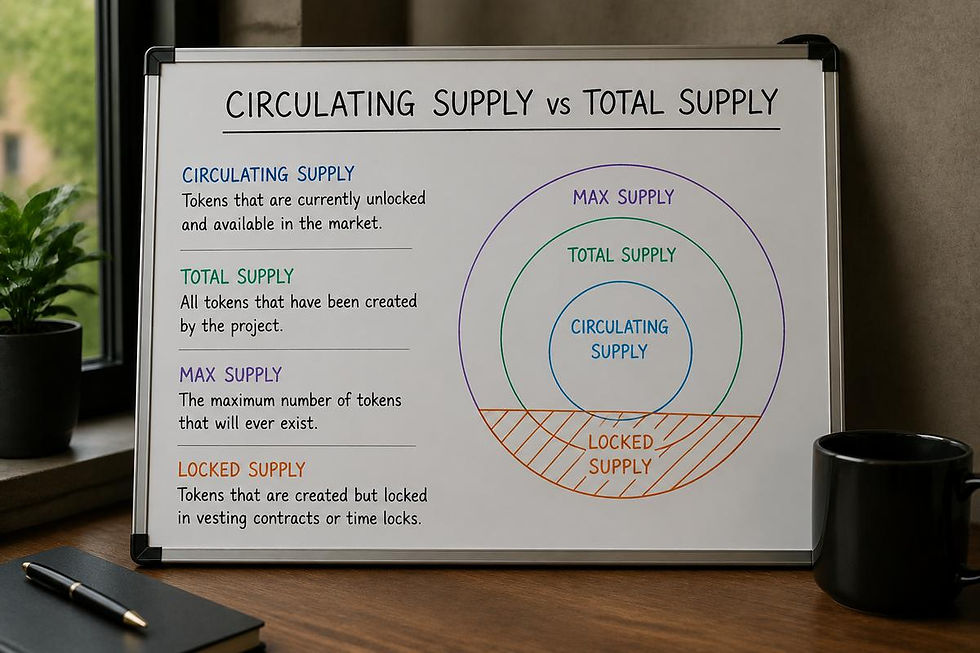
Token unlocks in crypto are closely linked to supply data. Beginners often look at price first. But supply numbers can explain a lot about future risk.
A token can have several supply figures. Each figure tells a different story. The most important ones are circulating supply, total supply, max supply, and locked supply.
1) What Is Circulating Supply?
Circulating supply means the number of tokens available in the market. These tokens can usually be traded or transferred.
Market cap is based on circulating supply. The formula is simple.
Market cap = Token price × Circulating supply
For example, if a token trades at $2 and has 100 million tokens in circulation, its market cap is $200 million.
This number is useful. But it does not show the full supply risk. A token may have a low circulating supply today. More tokens may still unlock later.
2) What Is Total Supply?
Total supply means the number of tokens that already exist. This includes tokens in circulation and tokens that are still locked.
For example, a project may have 1 billion tokens in total supply. But only 150 million tokens may be circulating.
This means 850 million tokens may still be locked or reserved. These tokens can enter the market through future unlocks.
This is why total supply matters. It shows how much supply exists beyond the current market.
3) What Is Max Supply?
Max supply means the highest number of tokens that can ever exist. Some crypto assets have a fixed max supply. Others do not.
A fixed max supply can help investors understand the long-term cap. But it does not remove unlock risk.
Even with a fixed max supply, many tokens may still be locked. Future unlocks can still increase the circulating supply.
4) Where Token Unlocks Fit In
Token unlocks in crypto can increase circulating supply. This happens when locked tokens become available to holders.
The main risk is dilution. Existing holders may own the same number of tokens. But their share of the available market supply may become smaller.
This is why investors should not study price alone. They should compare circulating supply with total supply. They should also check how much supply is still locked.
A token with low circulating supply and high locked supply may face future pressure. A token with most supply already circulating may have lower unlock risk.
How Traders and Investors Use Token Unlock Data

Traders and investors use token unlock data to study supply risk. They also use it to prepare for possible price swings.
Token unlocks in crypto do not give a sure price signal. But they help the market understand when new supply may become available. This makes unlock data useful for short-term traders, long-term holders, and research analysts.
1) Short-Term Traders
Short-term traders often watch unlock calendars. They want to know when a large supply event is coming.
A major unlock can bring higher price movement. This may happen before the unlock date. It may also happen after the tokens become available.
Some traders avoid buying before a large unlock. Others may look for short-term trades around the event. Some may wait until the unlock is over before entering.
This approach is based on risk control. Traders know that large unlocks can change market behavior.
2) Long-Term Investors
Long-term investors use unlock data in a different way. They focus on future supply.
A token may look attractive today. But if most of its supply is still locked, the long-term risk may be higher.
For example, a token may have only 10% of its supply in circulation. The rest may unlock over the next three years. This can create pressure if demand does not grow.
Long-term investors check the full vesting plan. They also check how much supply is still locked. This helps them judge whether the token has a healthy supply structure.
3) Research Analysts
Research analysts use token unlock data to study tokenomics. They compare unlock schedules across projects.
They may check investor allocations. They may also check team tokens and treasury unlocks. They look for signs of high insider supply.
A project with slow and clear vesting may be viewed better. A project with large early unlocks may face more concern.
Analysts also compare market cap with fully diluted value. A large gap between the two can show that many tokens are still waiting to enter the market.
4) Project Communities
Token unlocks also matter for project communities.
Community members want to know if the team and early investors are aligned with long-term growth. A clear vesting schedule can build more trust.
If a project hides supply details, the market may become cautious. If a project shares unlock data clearly, users can make better decisions.
This is why token unlocks in crypto are more than just trading events. They are also trust signals.
Still, unlock data should not be used alone. It should be combined with project growth, user activity, trading volume, and market trend. A token unlock is one signal. It is not a full investment case.
Learn More: Trading Strategy Around Market Events
How to Track Upcoming Token Unlocks
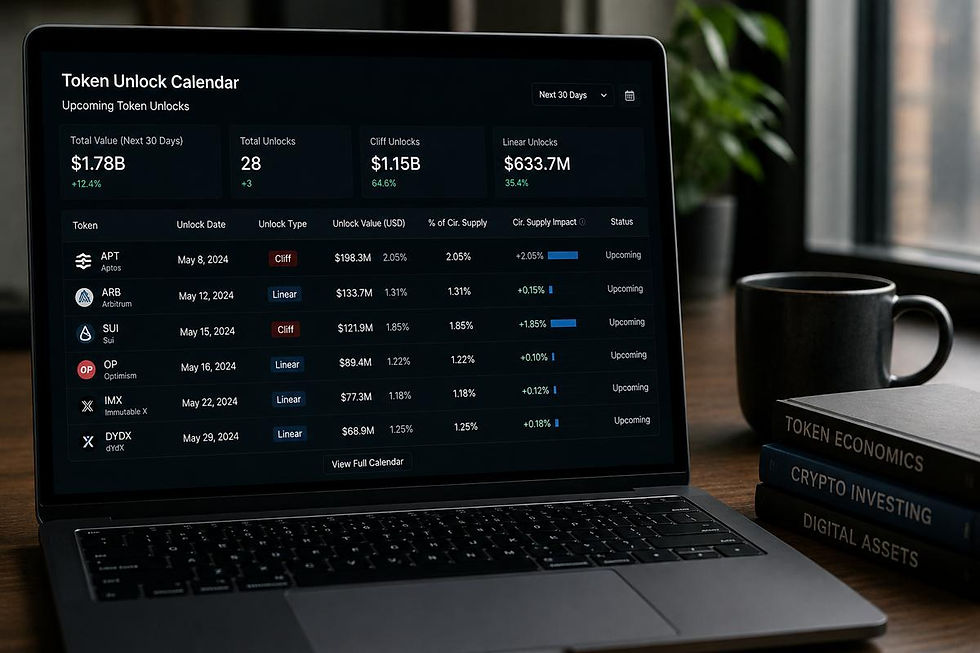
Tracking upcoming unlocks is a key step before buying any token. It helps investors see when new supply may enter the market.
Token unlocks in crypto are usually listed on public dashboards. These tools show unlock dates, token amounts, and the value of upcoming releases. Some also show which group will receive the tokens.
1) Token Unlock Dashboards
Token unlock dashboards are the easiest place to start.
Popular tools include CoinGecko, CoinMarketCap, Messari, Tokenomist, and CryptoRank. These platforms track unlock dates for major crypto projects.
They may show the number of tokens set to unlock. They may also show the dollar value of the unlock. Some dashboards show the unlock as a share of circulating supply.
This data helps investors compare risk across tokens. A small unlock may not matter much. A large unlock before weak market demand may need more care.
2) Project Documentation
Investors should also check official project sources.
These may include the whitepaper, tokenomics page, official blog, investor updates, and governance forum. Many projects publish vesting details before launch.
Official documents are useful because they explain how the token supply was planned. They may also show team allocation, investor allocation, treasury supply, and community rewards.
Still, investors should not rely on one source alone. Unlock data can change after token migration, governance votes, or supply updates.
3) Exchange Research Pages
Some exchanges publish research reports on listed tokens. These reports may include token supply data and vesting details.
Exchange research pages can be helpful for beginners. They often explain tokenomics in simple terms.
But these pages may not always be updated after launch. Investors should compare them with live dashboards and official project updates.
4) On-Chain Explorers
Advanced users can also use blockchain explorers. These tools help track wallet activity and vesting contracts.
For example, investors may watch treasury wallets. They may also check large transfers after an unlock. Exchange deposits can be important as well.
If unlocked tokens move to exchanges, the market may expect selling pressure. If tokens remain in wallets, the risk may be lower in the short term.
Tracking token unlocks in crypto is not about predicting price with certainty. It is about knowing when supply risk may rise. A smart investor checks unlock data before the market reacts.
Example Token Unlock Analysis Framework

A token unlock should be checked with a simple process. The goal is not to predict the exact price. The goal is to understand the supply risk before the event happens.
Token unlocks in crypto can affect each project in a different way. A large unlock may be serious for one token. The same unlock may be less important for another token with strong demand and high trading volume.
This framework can help investors study an upcoming unlock in a more structured way.
Step 1 — Find the Next Unlock Date
The first step is to find the next unlock date. This can be checked on a token unlock calendar.
The date matters because markets often react before the actual event. Traders may reduce risk early if they expect selling pressure.
Investors should also check whether the unlock is a one-time event or part of a monthly release plan.
Step 2 — Check the Unlock Size
The next step is to check how many tokens will unlock.
The token amount alone is not enough. Investors should also check the dollar value of the unlock.
For example, if 15 million tokens unlock at $4 each, the unlock value is $60 million. This gives a clearer view of the event size.
Step 3 — Compare It With Circulating Supply
The unlock should be compared with the current circulating supply.
This is one of the most important checks. A 2% unlock may be easier to absorb. A 20% unlock can create higher risk.
A large increase in available supply can affect price if demand is weak. This is why token unlocks in crypto should always be checked as a percentage of circulating supply.
Step 4 — Identify Who Receives the Tokens
The next step is to check the recipient.
Investor unlocks may create concern. Early investors may have bought tokens at a lower price.
Team unlocks may also draw attention. The market may watch whether insiders move tokens to exchanges.
Ecosystem unlocks may be different. These tokens may support grants or user rewards. Still, they can create pressure if recipients sell them fast.
Step 5 — Compare Unlock Value With Daily Volume
Daily trading volume shows how active the market is.
If an unlock is worth $80 million and daily volume is $20 million, the market may struggle to absorb the new supply.
If daily volume is much higher than the unlock value, the risk may be lower.
This does not remove the risk fully. But it helps investors judge whether the market has enough buying activity.
Step 6 — Check FDV and Remaining Locked Supply
Investors should also check the gap between market cap and FDV.
A large gap may show that many tokens are still locked. This means the current unlock may not be the last major supply event.
A token with repeated large unlocks may face long-term pressure. This is especially true if user growth is slow.
Step 7 — Review Market Sentiment
The broader market can change the result of an unlock.
In a strong market, buyers may absorb new supply. In a weak market, traders may react more sharply.
Bitcoin trend also matters. Sector demand matters as well. A gaming token, DeFi token, or AI token may react based on its own sector trend.
Step 8 — Make a Balanced Decision
A token unlock should not be treated as a sure sell signal. It should be treated as a risk check.
Investors should ask a few basic questions before buying.
Is the unlock large?
Who receives the tokens?
Is trading volume strong?
How much supply is still locked?
Is the project growing fast enough to absorb new supply?
This process gives a clearer view of the risk. It also helps investors avoid emotional decisions around token unlocks in crypto.
FAQs About Token Unlocks
1) What are token unlocks in crypto?
Token unlocks in crypto are scheduled events where locked tokens become available. These tokens may go to teams, investors, advisors, foundations, or community reward pools.
The tokens may already exist before the unlock. But they cannot move freely during the lockup period. After the unlock, holders can transfer, sell, stake, or use them.
2) Why do token unlocks affect price?
Token unlocks can affect price because they may increase available supply. If more tokens enter the market, buyers need to absorb that supply.
If demand is weak, the price may face pressure. If demand is strong, the market may handle the unlock better.
The impact also depends on trading volume. A token with low volume may react more sharply to a large unlock.
3) Do token unlocks always make prices fall?
No, token unlocks do not always make prices fall.
An unlock only means tokens become available. It does not mean holders will sell at once.
Some holders may keep their tokens. Some may stake them. Some foundations may use unlocked tokens for grants or project growth.
Still, token unlocks in crypto should be treated as risk events. They can increase supply pressure if demand is not strong.
4) What is a cliff unlock?
A cliff unlock happens after a fixed waiting period.
For example, investor tokens may stay locked for 12 months. After that, a large portion may unlock on one date.
Cliff unlocks often get market attention. This is because a large amount of supply may become available at once.
5) What is linear vesting?
Linear vesting means tokens unlock slowly over time.
The release may happen daily, weekly, or monthly. For example, a project may unlock 5 million tokens every month for two years.
Linear vesting can reduce the risk of a sudden supply shock. But it can still create pressure if the release size is large.
6) Are team token unlocks bad?
Team token unlocks are not always bad. They are normal in many crypto projects.
A long vesting period can show that the team is tied to the project for a longer time. This can support market trust.
But large team unlocks may raise concern. The market may worry about insider selling. This risk is higher when the project is weak or unclear about token use.
7) How can investors check upcoming token unlocks?
Investors can use token unlock dashboards. Common sources include CoinGecko, CoinMarketCap, Messari, Tokenomist, and CryptoRank.
They can also check official project documents. These may include the whitepaper, tokenomics page, blog posts, and governance forum.
For deeper research, investors can also check on-chain data. Wallet transfers and exchange deposits may show how unlocked tokens are moving.
8) What is the difference between token unlocks and token emissions?
Token unlocks usually refer to locked tokens becoming available. These tokens were already set aside under a vesting plan.
Token emissions usually refer to tokens released through rewards. This may include staking rewards, mining rewards, or liquidity rewards.
Both can increase supply over time. Both can affect price if demand does not grow.
9) Should beginners avoid tokens with upcoming unlocks?
Beginners do not need to avoid every token with an upcoming unlock. But they should study the event before buying.
They should check the unlock size. They should also check who receives the tokens. Trading volume and circulating supply are also important.
A small unlock may not matter much. A large unlock for early investors may carry more risk.
10) What is a good token unlock schedule?
A good token unlock schedule is clear and gradual. It should not release too much supply too early.
It should also align the team and investors with long-term growth. Longer vesting periods can help build trust.
A strong schedule gives the market enough time to absorb new supply. It also reduces the risk of sudden selling pressure.
Final Thoughts!
Token unlocks in crypto are important because they show when locked supply may enter the market. They do not always cause a price drop. But they can change how traders and investors view a token.
The main issue is supply. When more tokens become available, the market needs enough demand to absorb them. If demand is weak, price pressure may rise. If demand is strong, the market may handle the unlock with less stress.
This is why unlock size matters. A small unlock may have little effect. A large unlock can become a major risk event. The risk is higher when the unlock goes to early investors or insiders.
Investors should also check the wider supply picture. A token may have a small circulating supply today. But it may still have a large locked supply. This can create future dilution risk.
Token unlocks in crypto should not be used as a single trading signal. They should be part of a wider research process. Traders should check the unlock date, unlock value, holder group, daily volume, and market trend.
A clear and gradual unlock schedule can support trust. It gives the market time to absorb new supply. It also keeps teams and early backers tied to the project for longer.
A sudden or large unlock can increase risk. This is especially true when market demand is weak.
For beginners, the best approach is simple. Check the token unlock schedule before buying. Understand how much supply is still locked. Then judge whether the project has enough demand to support future releases.
For clear crypto insights and practical market guides, make BitCoinBlog a regular part of your research routine. Visit BitCoinBlog for fresh explainers, tokenomics updates, and useful crypto learning resources.
Learn More: Beginner Guides Before Investing

JAN MATULA
Founder of Bitcion.Blog
Graduate of Bratislava University of Economics and Business, experienced Forex and Stocks trader since 2008, early Bitcoin investor and crypto trader since 2021.
This content is for informational purposes only and should not be taken as solicitation, recommendation, endorsement or investment advice. It is crucial for you to conduct your own research and due diligence to make informed decisions, as any investment will be your sole responsibility. Please review our disclaimer and risk warning.


